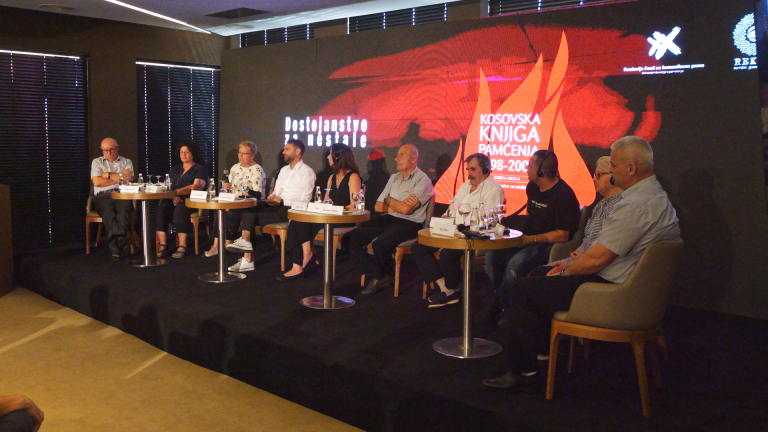

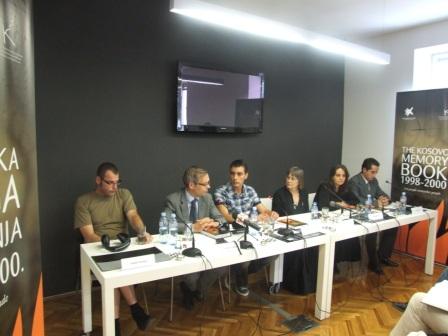
 BELGRADE, 09/08/2011 – Today, September 8, 2011, on the premises of the Humanitarian Law Center (HLC), the first volume of the Kosovo Memory Book: 1998 was promoted. The book deals with human losses in Kosovo in 1998. The follwoing speakers took part in the promotion: Mr. Nils Ragnar Kamsvag, Norwegian Ambassador; Natasa Kandic, Director of HLC; Bekim Blakaj, Director of HLC-Kosovo, Olgica Bozanic from the Associations of Families of Victims and Missing Persons; Slobodan Kostic, journalist; and Vladimir Arsenijevic, writer. The presentation was attended by family members of victims and missing persons, NGO representatives, representatives of the diplomatic corps in Serbia, as well as judges and prosecutors. None of the politicians or senior government officials attended the event.
At the beginning of the presentation, Natasa Kandic pointed out that instead of numbers, this book discloses the full names of people who died or were disappeared, and provides accounts of the situations in which they died or disappeared. “We wanted to put an end to the phenomenon of nameless victims in the Balkans,”
said Kandic, adding that such an approach changes the culture of collective memory and prevents manipulation of numbers. As a long-term goal she indicated the intent “to leave a clean bill to the future generations.”
Olgica Bozanic from the Association of Families of Kidnapped and Missing Persons from Kosovo and Metohija, emphasized how much the book means to her personally, as she herself lost 14 members of her extended family during the conflict in Kosovo. Speaking about the difficult struggle of discovering the truth about the missing loved ones, and about reliving the painful experiences while reading theKosovo Memory Book: 1998, Bozanic defined the publication as an additional document on which all families of missing persons can rely in the pursuit of the truth about their loved ones.
His Excellency Mr. Kamsvag expressed satisfaction that the Norwegian government supported such an important project. Norway supports the efforts of civil society in the search for truth and in helping the victims of war conflicts, he said. Bekim Blakaj, Director of the HLC in Kosovo, explained the methodology of data collection, the variety of sources consulted, and the process of comparing and determining the facts. HLC researchers in Belgrade and Pristina were going from village to village, recording the information and statements, and comparing them with the data from other organizations and sources. Blakaj emphasized the difficulties of a process which involves so many data, but noted that the hardest for him personally was working with the families. “They all expect their loved ones to return some day,” concluded Blakaj.
Vladimir Arsenijevic stressed the important impact the book may have on the wider community, not only those directly impacted by the war. He pointed out that the Kosovo Memory Book is a “measure of neutrality toward death” which refuses to divide the human losses along ethnic and national lines.
The Kosovo Memory Book: 1998 is the first volume of a much larger project. Within the series Kosovo Memory Book, HLC experts and researchers from Belgrade and Pristina will process and present all human losses in Kosovo in the period from January 1, 1998 until December 31, 2000. The Kosovo Memory Book “is becoming a witness whom no one will be able to bypass,” concluded Kandic.