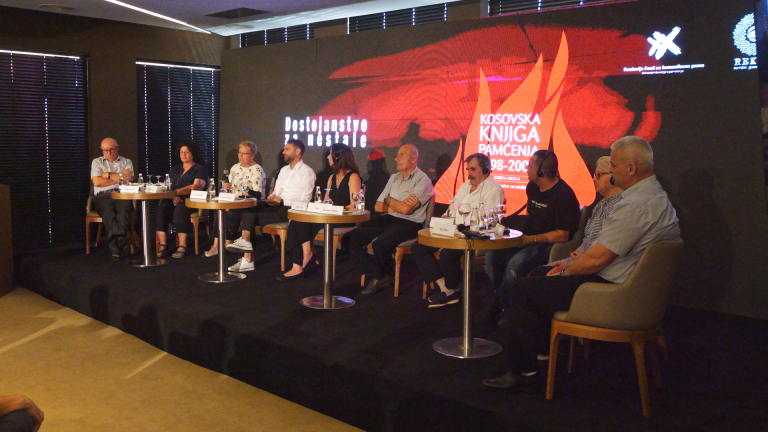

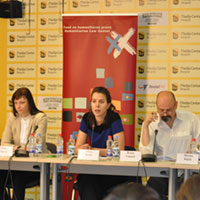
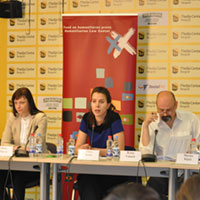
 On Thursday May 18th 2017, the Humanitarian Law Center (HLC) presented its sixth report on war crimes trials in Serbia. The report includes an analysis of 28 cases that were conducted before the courts in Serbia in 2016, placing them in the socio-political context that affects their processing.
Milica Kostić, the Legal Program Director at the HLC, emphasized that the Report on war crimes trials in Serbia in 2016 is still the only source of comprehensive information on the initiation of criminal justice for these serious crimes in Serbia. She also presented to the public two parallel but mutually contradictory processes: the adoption of the necessary strategic and operational framework for efficient trials, and the diversion of trials by the failure to elect a chief prosecutor for war crimes for over a year. The other events that marked the year 2016 included the first absence of representatives of the Office of the War Crimes Prosecutor (OWCP) from the regional meeting of prosecutors’ offices, a legal ban on genocide denial except for the Srebrenica genocide, and an intensified glorification of war criminals in the political and social public scene in Serbia. The conclusion must be that within Serbian institutions there is no real will to prosecute war crimes in an efficient and objective manner, and that all the necessary reforms in the framework of the process of accession to the EU need to be approached very thoroughly.With only 56 days of trials in 2016, it is clear that there is now a tendency towards the slow termination of war crimes trials in Serbia.
The author of the report, Marina Kljaić, herselfa legal representative of the victims,pointed to the continued trend of low efficiency in the OWCP’s work in 2016. This low level of efficiency was primarily reflected in the small number of indictments with a small number of indictees, the lack of indictments for crimes committed in Kosovo, the failure to prosecute high-ranking perpetrators, and the reliance on the work of other prosecutors’ offices in the region from which the OWCP takes over already prepared cases. Ms.Kljaić particularly warned of a significant deterioration of the status of injured parties and victims, mainly due to administrative procedures that do not recognize the importance of witnesses in war crimes cases. In fact, since the beginning of 2016, the courts have required witnesses to self-finance their attendance at trials, with subsequent refunding. A large number of witnesses cannot afford that initial cost, especially in situations where they reside in other countries. The witnesses who cannot afford to come to testify are faced with the threat of a fine for failing to respond to the court, or forced apprehension. In view of this problem, the HLC proposed that the care of witnesses should be handed over completely to the specialized Service for the Support and Assistance to Victims and Witnesses.
Deputy War Crimes Prosecutor Bruno Vekarićemphasized three key requirements for a more effective prosecution of war crimes: the election of a new prosecutor, the existence of a strategic framework, and intensive regional cooperation. The election of a new Chief Prosecutor for War Crimes has unblocked a number of measures, such as the adoption of the prosecutorial strategy, while the National Strategy for the Prosecution of War Crimes has for the first time established a necessary directional and focusing framework with defined priorities. According to the Deputy Prosecutor, despite some problems in 2016, regional cooperation has never been interrupted and the communication with regional prosecutor’s offices has never stopped. However, Vekarić agreed with the finding that the unresolved relations between Serbia and Kosovo prevent the effective prosecution of crimes committed in Kosovo, and he called for an urgent resolution of this issue through Brussels negotiations.
Responding to objections about the work of the OWCP, Vekarić emphasized that the number of indictments is conditioned by the capacities of the OWCP. Specifically, the cases with a large number of victims and the hundreds of cases in preliminary investigation proceedings, require the involvement of more than the five assistant prosecutors who are currently employed at the OWCP. Nevertheless, the Deputy Prosecutor insisted that the OWCP has taken efficient action in all the criminal complaints that it has received, including those that involve high-ranking perpetrators. He agreed with the proposition made by the HLC to hand over the care of witnesses to a specialized service, stressing that the current method of treatment exhausts witnesses significantly.
Illustrating the weak presence of war crimes trials in the awareness of the Serbian public, a journalist with the daily newspaper”Danas”,Jelena Diković,pointed to the fact that most citizens cannot name a single case, or an institution that deals with war crimes. Those responsible for this state of affairs are primarily the relevant institutions, which are ignoring their obligation to inform the public about these trials and their findings. For example, the judgments in cases of war crimes are published only on the websites of the OWCP and the Court of Appeals, and never on the High Court website. Moreover, even when journalists file requests demanding access to relevant documents, these documents are often anonymized to the point where any acquisition of information from them or any analysis are no longer possible. According to Diković, the journalists at ”Danas” often receive indictments, but also the court’s prohibition to publish most data.
The responsibility for the lack of knowledge about war crimes trials among the general public lies with the media as well as the institutions. In Serbia, only a handful of media, and even fewer journalists, follow this subject. Those who do follow and report on war crimes trials are subjected to daily pressures.
Referring to the number of prosecutions for war crimes before domestic courts, journalist Rade Radovanović calls Serbia „a country safe for war criminals“. Pursuing this finding further, Ms. Kostić pointed out that convicted war criminals receive a very good prison treatment, which includes holidays and weekends spent at home. She raised the question of the treatment of those accused of war crimes, observing that not one of the persons accused of war crimes in Serbia is in custody.Treatment of war crimes convicts clearly shows the attitude of the society and Serbian institutions towards the crimes.
[hana-flv-player video=”https://www.hlc-rdc.org/wp-content/uploads/2017/06/Predstavljanje_Izvestaja_o_sudjenjima_za_RZ_za_2016,_MC,_18.05.2017.mp4″ width=”480″ description=”Are war crimes trials in Serbia dying out?” player=”5″ autoload=”true” autoplay=”false” loop=”false” autorewind=”true” /]