
 Oleksii Bida, an activist from the Center for Audio-visual Art, was abducted in early May 2014 in his hometown of Luhansk. Members of pro-Russian forces unlawfully detained, interrogated and tortured him for hours. He was released the following day and left Lugansk immediately. Oleksii had previously organized and participated in a number of events in support of the unity of Ukraine. Apart from this engagement, he was not involved in politics nor did he take part in the conflict. This was only one of many instances of human rights violations committed in the territories under the control of pro-Russian forces in Ukraine.
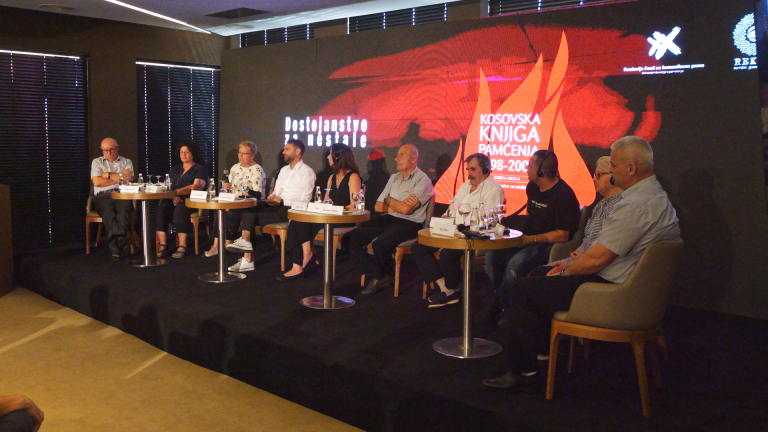
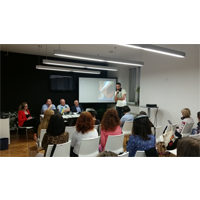
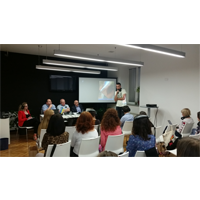
On May 12, 2015 a discussion was organized in the Humanitarian Law Center’s Library with representatives of “Justice for Peace in Donbas”, a coalition of non-governmental organizations from Ukraine. Volodymyr Shcherbachenko, the coordinator of the “Justice for Peace in Donbas” Coalition, Mykola Kozyrev from the Public Committee for the Protection of Constitutional Rights and Freedoms, and Oleksandr Pavlichenko from the Kharkiv Human Rights Group discussed the situation in the Luhansk and Donetsk regions and the endeavors to document human rights violations, while Marijana Toma, Deputy Executive Director of the HLC, moderated the discussion.
The principal message relayed by the Ukrainian activists was that while there may be different approaches, ideologies, and opinions with regard to the crisis in Ukraine, the discourse around the events should be focused on the principle of the rule of law. They emphasized that there is no rule of law in the regions of Luhansk and Donetsk; on the contrary, since the beginning of the crisis, citizens of these regions have been dealing with mass violations of human rights, including murders, torture, unlawful detention, unlawful confiscation of property, violation of the right to a fair trial, and a lack of freedom of expression, assembly and association. Unfortunately, after restoring control over certain territories, the authorities of the Ukrainian government have failed to conduct adequate investigations into these violations of human rights.
Following the initial difficulties of the work of the Coalition, which are the consequences of the different capacities and focuses of the organizations within the Coalition and a result of insufficient expertise in the area of international law, the Coalition today has developed forms for taking statements from victims and witnesses and established procedures for gathering information in the field. Since representatives of the Coalition rarely have an opportunity to conduct direct research, they have a number of different mechanisms which allow them to access information on human rights violations, including through people coming from the regions of Luhansk and Donetsk and through social networks. In cooperation with a number of Russian non-governmental organizations, including the Memorial, they have visited territories under the control of pro-Russian forces on several occassions. According to their statements, one of the consequences of working in such circumstances is the acceptance of the fact that, at this moment, it is impossible to investigate and document all cases.
In this regard, the assessment of human losses during the conflict in Ukraine may only be provisional. According to the information possessed by the Coalition, approximately one million people have left the regions of Luhansk and Donetsk, while the assessed number of casualties ranges from 7,000 to 10,000. Since there is still no common register of the killed, missing, and detained persons, the Coalition is planning to develop a methodology for registering human losses and the HLC’s experience shall be very helpful in this endeavor.
***
The “Justice for Peace in Donbas” Coalition is comprised of 15 non-governmental organizations, most of which are from the regions of Luhansk and Donetsk but several which are active at the national level. Organizations from Luhansk and Donetsk work outside these regions today because they were forced to leave them soon after the beginning of the conflict. The Coalition collects information on human rights violations for which pro-Russian and Ukranian forces, as well as a number of volunteer groups, are responsible. The information gathered will serve as the basis for initiating the prosecution of individuals responsible for human rights violations and the Coalition has already filed a number of applications with the European Court of Human Rights. They have been on their visit to the HLC since Monday, May 11th, in order to gain knowledge about documenting and preserving information on human rights violations and other mechanisms for establishing truth and responsibility for crimes committed. After visiting the HLC, the Coalition will also meet with Documenta – Center for Dealing with the Past, a Zagreb-based organization and a partner of the HLC. According to the representatives of the Coalition, the experience of the HLC with researching, collecting and storing information on human rights violations will significantly help their efforts to correctly document events in the east of Ukraine, and then to initiate mechanisms for establishing truth and responsibility for human rights violations committed in these regions.