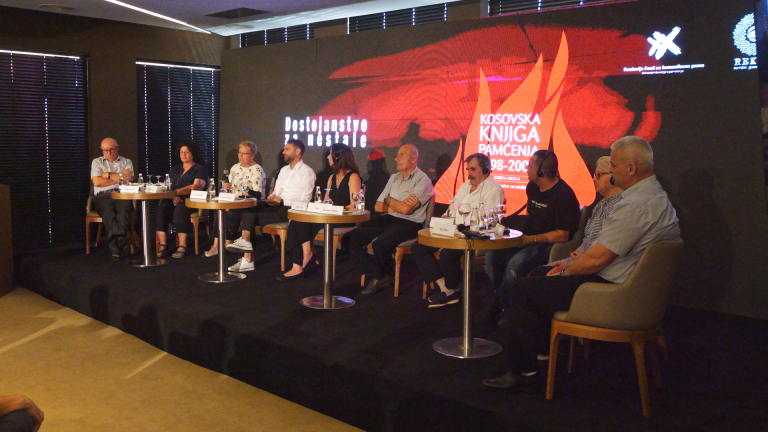

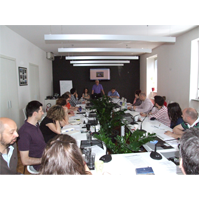
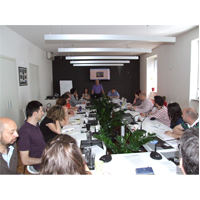
 The session of the focus group founded to meet the needs of the “Trial of Ratko Mladić and Legacy of the Hague Tribunal for Former Yugoslavia“ research project initiated by King’s College, London, was held on May 27th, 2014 in the Humanitarian Law Center Library. Representatives of non-governmental organizations, students and experts from various fields of interest participated in the work of the Group. The objective of the focus group was to trigger an exchange of opinions, ideas, perceptions, and views regarding the characteristics and course of the trial of Ratko Mladić before the International Criminal Tribunal for Former Yugoslavia (ICTY).
The finding that all the participants agreed upon was that the personal comportment and media representation of Ratko Mladić have contributed to the creation of a distorted image of the war and also to two conflicting narratives about the role of Ratko Mladić. He is perceived either as mentally unfit to stand trial or as an old man with the legacy of a family tragedy which may have affected and justified to a great extent his subsequent actions. He is often presented in such a manner as to create compassion and empathy. Thus, Ratko Mladić for certain people represents the symbol of a hero who fought for national interests, while for others, he is an out-and-out war criminal.
It has also been pointed out that the media have failed to use the historic opportunity that this case provides to start a general public debate about the war, the crimes, the responsibility and the victims. The reports that were published about the arrest of the accused were mainly sensationalistic and tabloid, whilst in the trial reports, they have mainly been relaying technical information related to the case, instead of focusing on the crimes that he has been charged with and thereby contributing to the raising of awareness about what really happened during the war in BiH. Such a media image is in part a result of the work of the ICTY Outreach, which has not managed to place this case at the centre of public attention.
However, one should bear in mind the fact that the trial of Ratko Mladić is being followed by two news agencies only, which points to the fact that the media are losing interest in this case. There has been the suggestion to focus not on the media, but on areas such as education, art, and advocacy for just and victim-sensitive policies.
The participants also pointed out that ICTY trials leave behind them voluminous material, which is available for various analyses. This court is also offering judicial practice in the area of international humanitarian law, many years after the Nuremberg Trials. The effect of preventing future crimes has been achieved by showing that anyone can expect to be held responsible for atrocities committed during armed conflicts anywhere in the world. As regards the region, the ICTY has contributed to the pacification of the region and has laid the foundation for the process of dealing with the past, which should be rewarded by the introduction and activation of other transitional justice mechanisms. Some negative critiques of the work of the ICTY were also aired.
[nggallery id=13]