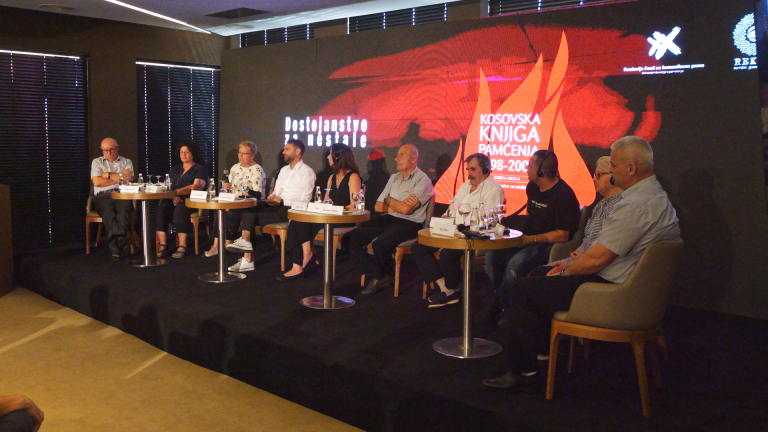

 Following the presentations in Zagreb and Sarajevo, the results from the list of human losses during the armed conflicts in Croatia, Kosovo, and partially in Bosnia and Herzegovina (BiH), as well as the list of detention sites in the armed conflict in BiH, were presented in Belgrade on December 15th, 2016. According to the research in progress, 13,535 persons were either killed or disappeared during the war in Kosovo, and 2,057 citizens of Serbia and Montenegro were killed or disappeared during the wars in Croatia and BiH, whereas approximately 160,000 citizens of BiH were detained in camps set up throughout the territory of that country.
At the opening of the presentation, RECOM Project Coordinator, Ms. Nataša Kandić, underlined that the objective of compiling this list of human losses and detention sites during the armed conflicts in the former Yugoslavia is to support and facilitate the work of the future Regional Commission for Establishing Facts About War Crimes in the Former Yugoslavia (RECOM). The work of RECOM on establishing facts about victims, perpetrators and witnesses would be assisted and alleviated to a great extent by having at its disposal the already established number of victims, and their names and the circumstances of their deaths/disappearances. She pointed out that this moment in time represents a unique and historical opportunity for establishing RECOM and that all post-Yugoslav countries should be aware of this.
Mr. Slaven Rašković from the Center for Dealing with the Past – Documenta, presented the results of the human losses record during the war in Croatia, with the presentation of two crimes committed in 1991. The first event happened in Sisak, where 59 Serbs were killed during 1991. Even though the victims were killed in separate incidents, one could detect a pattern according to which victims would disappear following their apprehension for the purpose of obtaining intelligence from them, and later on would be found in mass graves. The second example was the killing of 21 civilians of Croat nationality in the place known as Joševica near Glina on December 16th, 1991. The killings were committed by members of a paramilitary unit which was part of the then Army of the Republic of Srpska Krajina. This also followed a certain pattern, namely, members of the unit would enter private households and kill the residents, who were civilians, using the silencers on their guns.
Mr. Bekim Blakaj from the Humanitarian Law Center Kosovo announced that 13,535 persons were killed or disappeared during the war in Kosovo. This number includes 10,812 Albanians, 2,197 Serbs and 526 members of other ethnic communities (Roma, Ashkali, Egyptians, Bosniaks, etc.). Most of these victims were killed/disappeared on the territory of Kosovo (13,173), and most of them were civilians (10,111 victims). Even though the crimes were committed in all municipalities in Kosovo, there were still certain municipalities which were struck by more crimes than others, for instance, the municipality of Đakovica, where 1,669 people were killed.
The total number of victims of the war in Kosovo also includes 1,306 persons who were killed in the period June 10th, 1999 – December 31st, 1999. This number includes 715 Serbs, 318 Albanians, and 273 members of other ethnic communities.
The number of victims of the war in Kosovo also includes 213 children under the age of 7 and 1,275 persons over the age of 60.
Mr. Blakaj also reminded those present of 758 victims who were killed as a consequence of the NATO bombing. These victims included the two-year-old Mirjeta Kopalla and her mother Fatime (33), along with Bislim (3), Besart (6), Besime (8) and Besnik (16) Ramadani with their mother Fatime (36), and Marija (15) and her brother Nikola (17) Petrović, who were killed on May 1st, 1995 when a NATO projectile hit a bus in the village of Lužane near Priština.
Mrs. Dženana Karup Druško from the Transitional Justice, Responsibility and Memory Association presented the results from the list of detention camps and detention sites during the armed conflicts in BiH. According to the results of the ongoing research, there were 600 detention sites in Bosnia and approximately 160,000 detainees, including 88,000 Bosniaks, 12,500 Serbs, and 4,500 Croats. She also stated that the research relating to the detention sites faced certain limitations, since not all of the detainees had been registered, and there are many victims who are still reluctant to speak up and say what they know about these events. As a rule, these victims come from places where former prison guards or individuals who were directly involved in the torturing of victims are still at large and unpunished. One of the conclusions of the research is that the camps were used as a tool for ethnic cleansing – the territories where these camps were set up are ethnically clean today.
The results of the research also testify concerning 2,057 citizens of Serbia and Montenegro who were killed/disappeared during the wars in Croatia (1,114) and BiH (743).
* * *
The following organizations implement the research and the documenting of human losses in the wars in Croatia, BiH, and Kosovo: Humanitarian Law Center (Serbia), Humanitarian Law Center Kosovo, Center for Dealing with the Past – Documenta (Croatia), Transitional Justice, Responsibility and Memory Association (BIH) and Center for Democracy and Transitional Justice (BiH). These organizations believe that the establishing of all war crimes and the list of the victims of the wars represent tasks for the future regional commission RECOM, and that such an endeavour will finally put an end to the practice of remembering victims as numbers and not as people with names.
The results of the research will also be presented in Kosovo on Monday, December 19th, 2016.