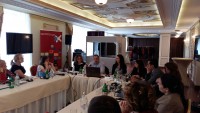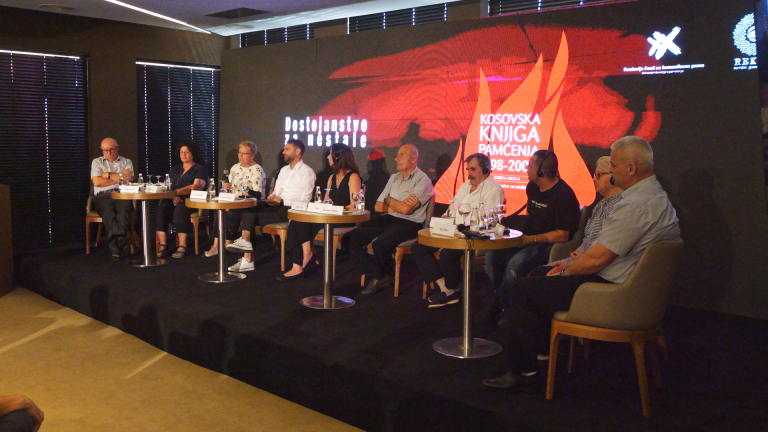

 The Humanitarian Law Center (HLC) held a conference entitled “Role of Education in the Reconciliation Process”, on April 20th, 2016, in which history teachers and civic education teachers, representatives of the Ministry of Education, non-governmental organizations and expert members of the public participated. The Conference is a part of the HLC’s education programme “Education for Reconciliation”, which was established in 2012 in the form of a regional and national programme of informal education in dealing with the past. The objective of the Conference was to present two proposals for practical policies in the area of education, which would be focused on research into the needs and models for introducing topics from the field of dealing with the past, transitional justice and reconciliation into university programmes, and which would represent recommendations and models for incorporating judicial facts about the events of the 1990s into history books.
Representatives of non-governmental organizations and teachers from schools in Serbia and Kosovo spoke about their experiences in incorporating lessons about dealing with the past into the formal and informal education programmes. HLC Kosovo is implementing an education programme which includes informal workshops and classes designed for high school students concerning transitional justice and armed conflicts in the former Yugoslavia. According to the research conducted by the HLC Kosovo, which was presented by its Executive Director Mr. Bekim Blakaj, the war in Kosovo is presented in Kosovo education programmes separately from other armed conflicts in the former Yugoslavia, with insufficient information about the events and biased presentations of the suffering of victims. A civic education teacher in a high school in Prishtina, Ms. Egzona Hyseni, emphasized that education could help decrease the distance between ethnic communities in Kosovo.
A history teacher in an elementary school in Batajnica, Mr. Aleksandar Todosijević, assessed that the existing history classes are dull and rely on chronological and statistical overviews of past events, presenting them mainly from a political aspect. The result of such an approach is insufficient knowledge of history and a distorted image of the past. In an attempt to improve history education and teaching methods, Mr. Todosijević has created a web page entitled History Classroom, which offers a great number of resources and contents to students and teachers, and which may be used in lessons about the past. A civic education teacher in the Railway Traffic School in Belgrade, Ms. Nada Banjanin Đuričić, presented her long-lasting work in developing methods for offering interesting contents about the Holocaust to students, thus motivating them to search for new knowledge on their own.
A professor at the Union University Faculty of Law, Mr. Saša Gajin, spoke about the potential and achievements of university education in Serbia in the reconciliation process. He underlined the dual role of universities in a transitional society such as the one in Serbia: adopting values which the youth will continue to affirm throughout their lives and professional work, and stimulating the process of reforms and transition towards a modern democratic society. According to him, universities in Serbia do not implement these functions, nor do they follow sufficiently the modern trends and achievements of higher education institutions throughout the world. A former student of the HLC’s Regional School for Transitional Justice, Ms. Višnja Šijačić, offered her view on the importance of educating youth about the events of the past. Owing to the lack of transitional justice programmes at universities in Serbia, she had to obtain her education in these matters through informal programmes and through independent research.
During the Conference, the HLC presented its fifth issue of the Forum for Transitional Justice. The Deputy Executive Director of the HLC and Editor, Ms. Marijana Toma, and one of the authors, Mr. Ivan Jovanović, an expert in international law, spoke about this publication.