
Filter by Categories
Audit Reports
Awards
Blog
Calendar
Criminal Justice
Criminal complaints
Dossiers
Joint proceedings
Vetting
War crime trials
ICTY trials and before the courts in the other post-Yugoslav states
Before the internationalised courts in Kosovo
Bosnia and Herzegovina
Croatia
Montenegro
Transcripts
War crime trials in Serbia
Analysis
Individual Cases
Zone of (non)responsibility
Dajte potpis
Documentation
Dokumentovanje i pamcenje
Donatori
Education
Education
National School of Transitional Justice
Regional School of Transitional Justice
HLC Annual Report
HLC Archives
HLC Governing Board
HLC YouTube Channel
Human Losses
Data Base
Human Losses in Kosovo
Human losses in NATO bombing of Serbia and Montenegro
Human Losses in the armed conflict in Macedonia
Human losses of Serbia and Montenegro in the armed conflicts in Slovenia, Croatia and B&H
Kosovo Memory Book
Register of Croatian citizens of Serbian ethnicity, killed in the armed conflict in Croatia
Internships
Justice
Koalicija za REKOM
Kontakt
Linkovi
Memory
O nama
Others about HLC
Podcast
Pravda i reforma institucija
Public Information
Bulletin through ACCESSION towards JUSTICE
Conferences
HLC Video Production
Library
Magazine Forum on Transitional Justice
News
Press Releases
Reports
Transitional justice in focus
Video documents
Publications
Reparations
Financial Reparations
Symbolic Reparations
Reports on Transitional Justice
Search the Data Base of Human Losses of Serbia and Montenegro in the Period 1991-1995.
The RECOM Process
Transkripti
Uncategorized
Uncategorized @en
Vacancies
Video produkcija
15.04.2011.

Pictures of a War Crime Seminar at the HLC

King’s College from London organized the Pictures of a War Crime – Visual documents and the way they impact war crimes trials and the public seminar which was held at the offices of the Humanitarian Law Center in Belgrade.
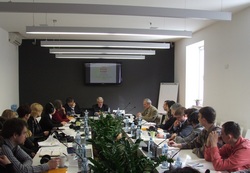
seminar_15_04_2011

James Gow (King’s College) made a presentation of preliminary findings of a research explaining that the photographs used in the research don’t necessarily show the very act of the commitment of a war crime, but that they will all certainly inspire viewers to think about why it is necessary to deal with war crimes. “Sometimes photographs of famous people attract more attention than the photographs of massacres. An example of that is the case of the famous model Naomi Campbell who testified about the crimes committed in Sierra Leon”, said Gow.

Merdijana-Megi Sadović (Institute for War and Peace Reporting) talked about the role of the media in instigating a conflict. She said that the photographs of crimes are mostly used in the media when there is an intention to remind viewers/readers of an event, to arouse emotions, or present a visual effect to illustrate an event.

“However, when used in hearings, photographs of mutilated bodies and mass graves have a a deeper impact”, said Sadović.

Speaking about visual documents, Nataša Kandić (Humanitarian Law Center) showed the video of the execution of six men in Srebrenica, explaining that the video could not be manipulated with or misinterpreted in any way because it allows viewers to clearly hear and see what happened.

“Although it clearly shows what happened in Srebrenica, this video was neither admitted as evidence in the trial of Slobodan Milošević at the ICTY nor was at admitted at the trial of the members of the “Scorpions” unit in Serbia”, said Kandić.
Tagovi:

Podržali:

Pogledajte još...

We use cookies to provide a better user experience and to enable the functioning of this presentation in accordance with our Privacy Policy and Terms of Use.
This site is registered on wpml.org as a development site. Switch to a production site key to remove this banner.