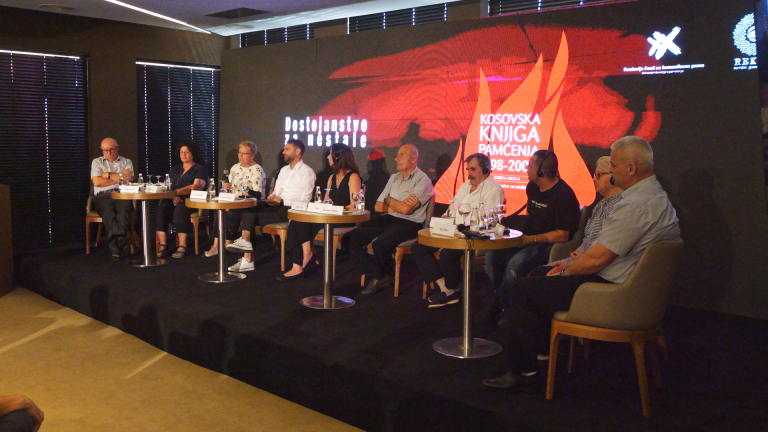

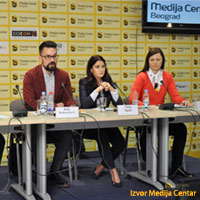
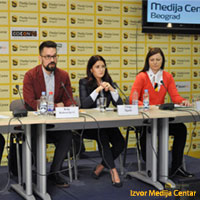
The Initial report on the implementation of the National Strategy for the Prosecution of War Crimes, and the results of the opinion polls on „Awareness of the citizens of Serbia about the wars of the 90s, war crimes and war crimes trials“, were presented on Monday, December 18 2017, at a conference organized by the Humanitarian Law Center (HLC) and the daily newspaper ‘Danas’.
The Initial report on the implementation of the National Strategy for the Prosecution of War Crimes provides an overview of the implementation of the strategy in the period since its adoption in February 2016 until September 2017. Initiating the discussion about the report, the HLC’s legal analyst Relja Radosavljević said that, on the basis of its negotiating position for Chapter 23, Serbia has an obligation to effectively prosecute those responsible for war crimes and to facilitate access to justice without discrimination for the victims of war crimes. The Report on the implementation of the National Strategy prepared by the HLC is the first in a series of reports that the HLC will publish up till 2020, which is the anticipated period for the implementation of the National Strategy. Radosavljević said that, so far, there has been an evident delay in the implementation of the Strategy. This delay was well illustrated by the establishment in September 2017 of the Working Group for Monitoring the Implementation of the Strategy, even though the deadline for its formation was 30 days from the adoption of the Strategy in February 2016. Mr Radosavljević also recalled that the EU, in its report on Serbia’s progress on the road to the EU in 2016, stated there was no progress in prosecuting war crimes, and he reminded everyone that the Serbian Minister of Justice, Nela Kuburović, stated in her address to the UN Security Council that Serbia is committed to prosecuting war crimes.
Introducing the Report, the author Višnja Šijačić stated the fact that, out of the 61 activities that the National Strategy proposes, 30 activities have not been implemented, while only 10 activities have been implemented.
Ms Šijačić then presented the key findings of the Report. One of the most important activities of the National Strategy is the adoption of the Prosecutorial Strategy, which should identify the priorities which the Office of the War Crimes Prosecutor (OWCP) will act on. By the date of the presentation of the Report, the Prosecutorial Strategy had still not been implemented. There has been no increase in the number of indictments since the adoption of the National Strategy, and the work of the OWCP is at its lowest level since 2003. She further stated that, given the passage of time, it will not be possible to process some cases. In some cases, some of the accused persons have died, while in other cases, injured party witnesses have declined to testify in trials when repeated. The example best illustrating the unreasonably long duration of the proceedings has been the Ovčara Case. Commenting on the latest European Commission Report on Serbia’s Progress (in 2016), Ms Šijačić quoted citations in which it is stated that no progress has been recorded in the area of procedural rights. In relation to the planned reduction of the number of missing persons, it can clearly be concluded that the dynamics of clarifying their fate does not adequately address the humanitarian dimension of this problem.
Concluding her speech, Ms Šijačić also commented on the harsh criticism addressed to Serbia by the Chief Prosecutor and the President of the Hague Tribunal. A series of negative evaluations of the prosecution of war crimes in Serbia was put forward by the relevant governmental and non-governmental organizations such as Amnesty International, Human Rights Watch and the US State Department.
Jelena Diković, journalist with the daily newspaper ‘Danas’, presented a public opinion poll that was aimed at examining the views of citizens about war crimes trials before the national courts and the Hague Tribunal, compensations for war victims, memorial monuments, the information provided by educational institutions and the general awareness of the events that happened during the wars of the 90s. The poll surveyed 1200 respondents.
Ms Diković pointed out that the general impression is that citizens are little informed about the trials before domestic courts. When it comes to attitudes towards the Hague Tribunal, the dominating one is that this Court has been biased, and that it has contributed little when it comes to ascertaining the facts about the wars in the former Yugoslavia. Citizens of Serbia are also criticial of the work of the Serbian government in the conduct of war crimes proceedings, as well as of the objectivity and impartiality of the War Crimes Prosecutor and the judges of the Department for War Crimes. However, despite this, there are two and a half times more respondents who claim that a fair trial for Ramuš Haradinaj is possible in Serbia than those who think a fair trial is not possible. She concluded that the citizens of Serbia are not interested in war crimes proceedings, that they are exposed to constant media propaganda and that they support revisionist tendencies.
Aleksandar Roknić, journalist with the daily newspaper ‘Danas’ presented the part of the research related to attitudes about individual guilt. 64% of respondents believe that Ramuš Haradinaj is guilty of what he is charged for, and only one in every hundred respondents thinks Haradinaj is not guilty. When these responses are viewed through the prism of the ethnic affiliations of the respondents, it can be said that no Serbs consider Haradinaj not guilty. Three quarters (77%) of respondents did not answer a question about the guilt of a certain Krešimir Horvat, a fictional character whose name and surname could be associated with membership of the Croatian nation, so it can be concluded these respondents did not „fall for“ this provocation.
A quarter of respondents (24%) think that Croats committed most of the crimes, and nearly half think that the Serbs had the highest number of victims (47%), in the wars in the former Yugoslavia. The majority of citizens are opposed to the rehabilitation of war criminals, and 77% of respondents support the view that it is not acceptable that convicted individuals enjoy an active participation in political life. 71% of respondents believe that war crimes suspects should not be allowed to perform government functions. Mr Roknić ended his presentation with the conclusion that citizens are generally so poorly informed about the events of the wars of the 90s, that 60% of respondents do not know what happened in Srebrenica and 71% do not know that Sarajevo was under siege for four years. 94% of respondents do not know about the existence of camps in the territory of Serbia during the war years of the 90s, 85% do not know of a single case tried before national courts, and 79% do not know of any state body participating in the prosecution of war crimes.