
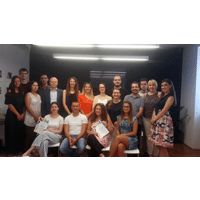
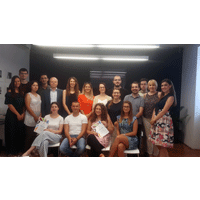
On Monday, July 30, 2018, the Fifth National School of Transitional Justice organised by the Humanitarian Law Center completed its course. The School participants were 25 students of law, security, political science and history, activists from NGOs, journalists, law apprentices and history educators from Belgrade, Surdulica, Mladenovac, Smederevo, Ribarica, Novi Sad, Kragujevac, Požarevac, Pančevo, Bor and Niš.
They acquired knowledge about the concept of transitional justice and its mechanisms, and its application in Serbia in the context of the armed conflicts in the former Yugoslavia, and considered the case studies of Srebrenica, Kosovo, Vukovar, Oluja, Hrtkovci, Skočić, and Zvornik. Besides the opportunity to learn about the court-established facts regarding these crimes, the participants were also able to assimilate some of the facts from the victims’ perspective. In this manner, they had the opportunity to hear about the experiences of Suvada Selimovic, from the town of Djulići near Zvornik, and Zijo Ribić, from the town of Skočić near Zvornik, who talked about pre-war life in their villages with their neighbours, about the war events they witnessed, and their fight for truth and justice after the war ended. The agenda also included a visit to monuments in Belgrade which bear witness to the currently dominant ethnically-biased manner of remembering victims’ suffering during the wars in the former Yugoslavia.
The participants said that during their formal education they never had the opportunity to receive knowledge such as that acquired at the HLC School. Even the very approach of the HLC School was new to the students, in which the reasoning process was stimulated and encouraged, rather than the uncritical acceptance of information, as well as mutual discussion and the formation of one’s own opinion on the key issues for dealing with the past, such as responsibility, guilt, ways of establishing justice, establishing the truth and the memory of the victims. They also expressed their satisfaction after visiting the monuments, which for the first time was included in the school agenda. The participants suggested that the topics of the lectures include the experiences of other post-conflict societies, such as Rwanda, South Africa and Latin America, and also of the other states that were involved in the wars of the 1990s, Croatia, Bosnia and Herzegovina and Kosovo. They considered it important for young people who have not had the opportunity to hear and to learn about transitional justice, as well as juniors within political parties, high school students and journalists, to be considered for similar educational programmes.
This year’s School of Transitional Justice was supported by the Embassy of the Czech Republic in Belgrade. According to the Deputy Head of Mission of the Embassy, Mr. Pavel Kobližka, the School of Transitional Justice has contributed to the dissemination of factually accurate information about events that many of the School participants do not even remember. “Searching for historical justice based on facts, and not on myths or distorted interpretations or concealment of events, is necessary for learning from the mistakes of the past and avoiding their repetition,” said Kobližka at the closing ceremony when diplomas were awarded to the School participants. He recalled his country’s experience in the post-World War II reconciliation process with their German neighbour, with whom they now enjoys friendly relations, as well as their outstanding relationship with Slovakia after a peaceful dissolution in 1993, which he believes can be an inspiration to many nations.