
Filter by Categories
Audit Reports
Awards
Blog
Calendar
Criminal Justice
Criminal complaints
Dossiers
Joint proceedings
Vetting
War crime trials
ICTY trials and before the courts in the other post-Yugoslav states
Before the internationalised courts in Kosovo
Bosnia and Herzegovina
Croatia
Montenegro
Transcripts
War crime trials in Serbia
Analysis
Individual Cases
Zone of (non)responsibility
Dajte potpis
Documentation
Dokumentovanje i pamcenje
Donatori
Education
Education
National School of Transitional Justice
Regional School of Transitional Justice
HLC Annual Report
HLC Archives
HLC Governing Board
HLC YouTube Channel
Human Losses
Data Base
Human Losses in Kosovo
Human losses in NATO bombing of Serbia and Montenegro
Human Losses in the armed conflict in Macedonia
Human losses of Serbia and Montenegro in the armed conflicts in Slovenia, Croatia and B&H
Kosovo Memory Book
Register of Croatian citizens of Serbian ethnicity, killed in the armed conflict in Croatia
Internships
Justice
Koalicija za REKOM
Kontakt
Linkovi
Memory
O nama
Others about HLC
Podcast
Pravda i reforma institucija
Public Information
Bulletin through ACCESSION towards JUSTICE
Conferences
HLC Video Production
Library
Magazine Forum on Transitional Justice
News
Press Releases
Reports
Transitional justice in focus
Video documents
Publications
Reparations
Financial Reparations
Symbolic Reparations
Reports on Transitional Justice
Search the Data Base of Human Losses of Serbia and Montenegro in the Period 1991-1995.
The RECOM Process
Transkripti
Uncategorized
Uncategorized @en
Vacancies
Video produkcija
12.07.2012.

“Who Can Erase the Traces?” The Role of Archives in the Promotion of Human Rights

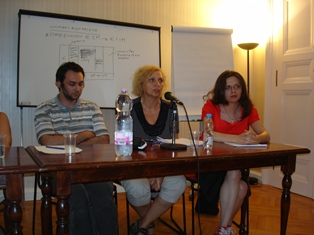
A panel discussion on the role of archives in the protection and promotion of human rights was organized as part of the Central European University Summer course on the ‘Policy and Practice in Access to Digital Archives’ held in the period July 2nd-6th, 2012 in Budapest. Archivist Stana Tadić represented the Humanitarian Law Center at this gathering.  Other participants in the panel discussion were Gabrijela Gavran, the Manager of the War Crimes Database at the University of Zagreb’s Faculty of Law, Gabriella Ivacs, Chief Archivist of the Open Society’s Archive in Budapest, Nikola Mokrović, an archivist from Documenta,Zagreb, and Alice Nemcova, an OSCE researcher-coordinator.

The participants discussed manners and methodologies for administrating such archives in Eastern and Central Europe, the role of documents and collections of documents created during the times of oppressive regimes, and the role they have in post-conflict societies. One of the topics of the discussion was also the use of archival material in the process of establishing criminal responsibility, its role in the reparation of victims and their families, as well as the use of these documents during later research and recontextualization of the documents.

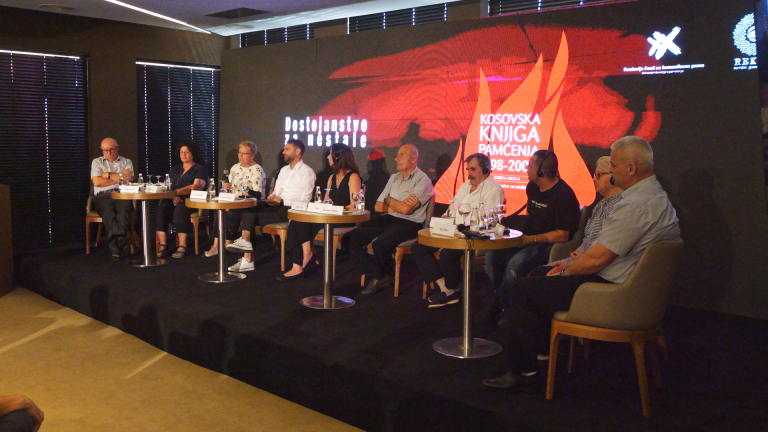
Stana Tadić mentioned the Kosovo Memory Book,  the Humanitarian Law Center is working on, as an example of the use of primary documents for the purpose of dealing with the past together with documents originally created for other purposes and which originate from other sources.  This book represents an example of how short narratives on victims of the conflict in Kosovo have been written on the basis of sfacts originating from various, primary and secondary, documents, managed to be obtained by the Humanitarian Law Center during the years of its research.

Tagovi:

Podržali:

Pogledajte još...

We use cookies to provide a better user experience and to enable the functioning of this presentation in accordance with our Privacy Policy and Terms of Use.
This site is registered on wpml.org as a development site. Switch to a production site key to remove this banner.