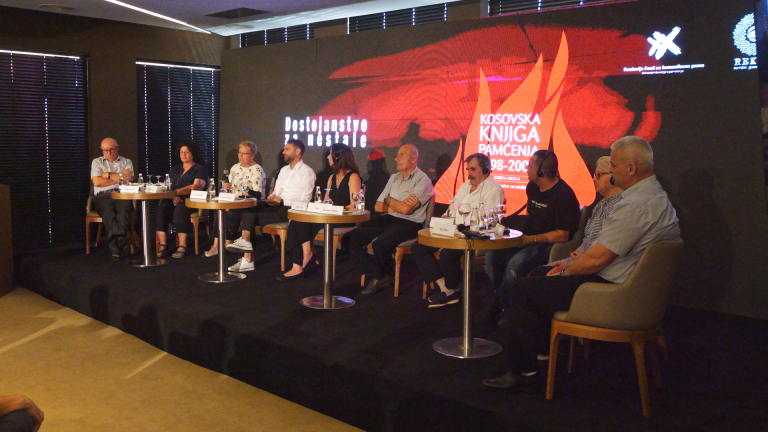

Official institutions of the Republic of Serbia are neglecting the fact that during the NATO bombardment of the Federal Republic of Yugoslavia (SRJ/FRJ) Serbian military and the police committed the most heinous war crimes in Kosovo.
The Humanitarian Law Center (HLC) recalls that, according to a number of independent sources, during the NATO bombardment in Kosovo over 10,000 Kosovo Albanians were killed in what was justified as the need to defend the country. Decisions handed down by the International Criminal Tribunal for the former Yugoslavia (ICTY) in the case of Nikola Šainović and police and military generals requires the government of the Republic of Serbia to investigate and punish perpetrators of all large scale crimes documented and entered into evidence during these trials.
The tenth anniversary of the NATO bombardment in Serbia and Montenegro goes without mentioning the Albanian victims in Kosovo, and their demise is once again being relativized and questioned. The number of Kosovo Albanians killed during the bombardment is factual and documented and those victims are not going to disappear only because the people in Serbia prefer to pretend they do not exist. The same way the government of Serbia is expected to identify and punish the perpetrators of these crimes, the people in Serbia are expected to be informed about these crimes and acknowledge them.
HLC recalls that the ICTY has shed light on several dozens of large scale crimes committed in Kosovo during the NATO bombardment and that the War Crimes Trial Chamber of the Belgrade District Court has been hearing three more cases of large scale murders. Apart from this, it should not be forgotten that there are dozens of other mass murders from the same period which are being flagrantly ignored, and that the perpetrators of these crimes are still at large.
At the very beginning of the bombardment, in the night between March 24 and 25, 1999, the eminent Kosovo lawyer Bajram Kelmendi and his two sons, Kushtrim and Kastriot, were killed. Fehmi Agani, one of the most prominent intellectuals and politicians in Kosovo and in the former Yugoslavia, was killed on May 6, 1999.
The calendar of mass murders is fully booked for almost every day of March and April, and it is also very busy in May and during the first days of June, 1999.
On April 1, 1999 a total of 136 people were killed in three mass crimes, and the following day, on April 2, in two separate large scale crimes 127 people were killed. The largest number of victims in Kosovo lost their lives in May when 334 persons were killed in one day in the villages of Meja and Korenica.
In just one day, on March 26, 1999, five mass crimes began, two of which lasted for several days: the crime in Suva Reka when 50 women and children were killed; in Mala Kruša and Prizren 146 people were killed; 20 people were killed in Padalište, 27 people were killed in Landovica and Prizren; 86 in Celina and Orahovac; 98 people were killed in Velika Kruša and again in Orahovac.
These days, the Serbian public should also remember the 850 victims from mass graves discovered at the police training site in Batajnica, and it should also be aware of several dozens of bodies found in the Perućac lake.
The Humanitarian Law Center would like to remind the public in Serbia that it is the obligation of the Republic of Serbia to tell the truth to the families of the victims about the crimes committed against their loved ones, thus demonstrating its readiness to acknowledge its responsibility for the crimes committed in the past on its behalf.
Contact person:
Jelena Grujic
Media coordinator
Tel/Fax: + 381 11 3444 313
E-mail: press@hlc-rdc.org