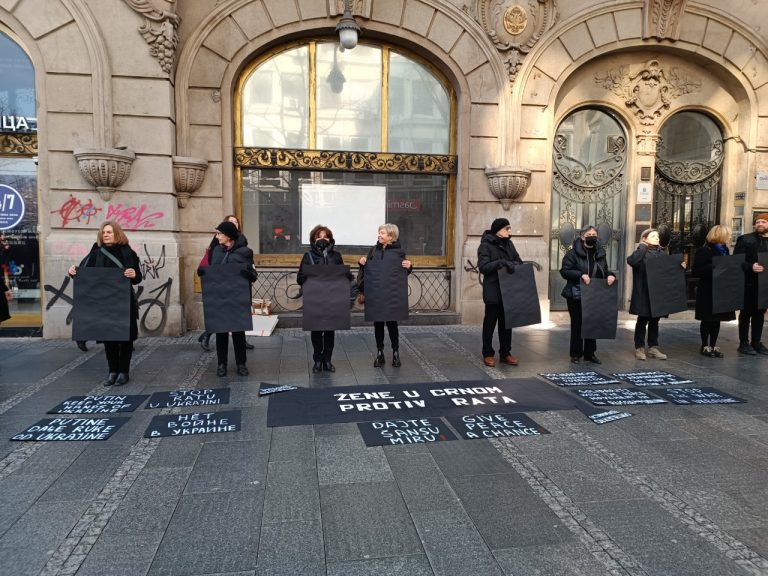

The government of the Republic of Serbia seriously limits the efforts to re-establish the rule of law by not arresting the International Criminal Tribunal for the Former Yugoslavia (ICTY) indictees who are still at large and hide on the territory of Serbia and by not carrying out reforms of the police, military and security services. The government continues to influence the War Crimes Prosecutor’s Office to prevent establishment of the truth about participation of Serbian institutions in planning, ordering and execution of crimes during armed conflicts in the former Yugoslavia. The government ignores its obligation to provide the victims’ families with the full truth on the fate of their loved ones and establish an appropriate reparation programme for the victims. What is more, the government fails to accept the need to establish a public platform for truth-seeking and truth-telling on the harms done to others in the name of Serbia, which is a condition for restoring dignity off all victims, including Serbian ones.
By not fulfilling its obligations in connection with arresting Ratko Mladic, Prime Minister Kostunica’s government demonstrated that Ratko Mladic is more important than building of Serbia’s democratic future based on the respect for the Law and human rights. Such government’s attitude leads to strengthening of political extremism in the Parliament and the society. Consequently, glorification of ICTY indictees, such as Ratko Mladic and Vojislav Seselj, is a common theme in the Serbian Parliament and is supported by a majority of MPs.
It is obvious that parts of police and military security agencies, loyal to the former ideology that endorsement of Hague indictees is in Serbia’s national interest, play a major role among those who protect the ICTY indictees. Such factions do not believe that establishing individual responsibility of those indicted before ICTY as well as establishing institutional responsibility is in Serbia’s interest. They maintain friendly relationship with the current political elites whose aim is not to build responsible institutions but to remain in power and thus prevent critical reflection on the past.
Facts and documents on responsibility of individuals as well as on involvement of police and army in war crimes are held by the government under direct control of groups and individuals who have a de facto power in those institutions. Former police services, prosecutors and judges who formally operate on the territory of Serbia as Kosovo institutions which are temporarily dislocated to Serbia, play an important role in withholding the traces of crimes committed in Kosovo.
The government and political elites are not willing to commit to recognising the victims of crimes committed by Serbs by establishing a programme of symbolic and monetary reparations and thus demonstrating that those victims are important to the Serbian government and Serbian citizens. The victims rather fulfil their right to reparation exclusively though non-governmental human rights organisations that file compensation claims on their behalf.
However, there are still aspects of Serbia which demonstrate that not everything has a backward trend. Unlike prosecutors who insistently protect institutions of the old regime, war crimes trials are conducted in a most professional manner. The judges are loyal to the law and show utmost respect for both victims’ rights and rights of the accused. In the course of all war crimes trials to date as well as the current trials known to the public – “Podujevo”, “Ovcara”, “Skorpioni”, “Zvornik”, and “Suva Reka”, the judges were guided by facts and evidence trying to shed light on the context behind the events and thus complete the picture of the responsibility or innocence of the accused.
Non-governmental human rights organisations support domestic war crimes trials through direct participation in the processes, securing documentation and victims/witnesses as well as representation of victims/witnesses before the court. Thanks to the Humanitarian Law Center, all those trials were monitored by victims’ families who were thus able to follow the procedure to establish justice and independently assess whether justice was served. The presiding judges in cases “Ovcara” and “Podujevo” faced the situation of victims thanking them for their unbiased trials and their effort to establish justice.