
 On July 24 2016, the broadcasting of the series “People and Memories Talk”, a documentary programme which recorded the testimonies of victims of all nationalities from the wars in the former Yugoslavia, was suddenly terminated, following a decision made by the new management of Radio Television of Vojvodina (RTV). The Humanitarian Law Center (HLC) believes that such a decision is contrary to the Law on Public Information and Media (available in Serbian) and the proclaimed mission of the RTV (available in Serbian), and that it is also an act of censorship and a missed opportunity for a public media service to make a contribution to reconciliation and the normalization of relations with neighbours in the region.
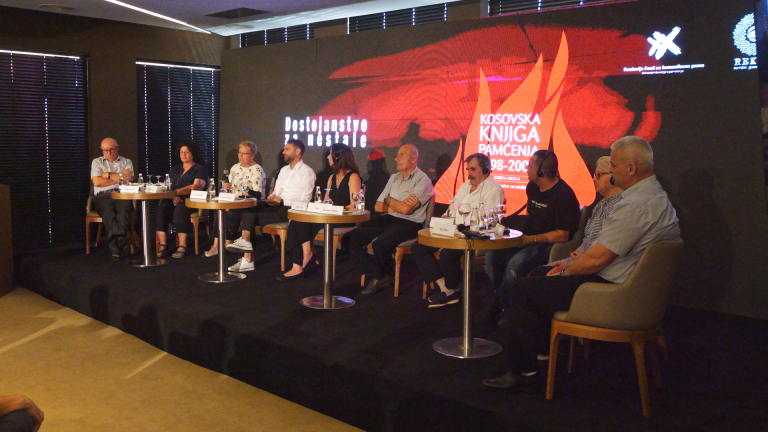
The series was co-produced by the human rights organizations Integra (Kosovo), Documenta (Croatia), HLC (Serbia), Association of of Concentration-camp Detainees “Prijedor ’92” (Bosnia and Herzegovina) and the Center for Research and Policy Making (Macedonia). In the series, the victims of all nationalities speak about their sufferings and the fates of their family members who were killed in the wars in Croatia, Bosnia and Herzegovina, Macedonia and Kosovo.
Under the previous agreement between RTV and the HLC, since May of this year, the series had been broadcast on Sunday nights, but the new management of RTV stopped the broadcasting without any explanation. The last episode was broadcast on July 24th, 2016. For an entire month since then, the HLC was trying unsuccessfully to obtain an answer by phone or email to the question relating to the reasons for the change in the programme schedule.
Only when a request for access to information of public importance was sent out, Miodrag Koprivica, Director-General of RTV, replied (available in Serbian) that „the reason for the termination of the broadcasting of the series is the lack of interest for programmes of this format“. It is also stated in this reply that the decision to ban future broadcasts of testimonies of victims of war crimes was adopted by Nada Kalkan, the Editor-in-Chief of RTV’s programme 1.
The HLC believes that the reasoning of the new management of RTV is inappropriate and incomplete, and the decision on the termination of the broadcasting of the series “People And Memories Talk” is contrary to the proclaimed mission of the Vojvodina public service, which is „to contribute to the enrichment of information and knowledge and the development of civil society“. On the contrary, the decision to abruptly terminate the broadcasting of a programme containing the testimonies of the victims of war is an indicator of censorship on a television station which should instead be a service for all the citizens of Vojvodina.
The decision of the RTV programme editor drastically deviates from objectives of the Law on Public Information and Media such as „advancing the values of a democratic society, prevention of conflict and preservation of peace.“ In fact, this decision comes at a time of disturbed relations between the countries in the region caused precisely by the unresolved issues from the recent wartime past. Instead of making it possible for the testimonies of victims of all nationalities to be heard, which is a precondition for reconciliation and easing of tensions, the Vojvodina public service has decided to silence them with the overt message that „there is no interest in the programme schedule“ for their stories .
The first episode, aired in May 2016, contained the testimony of Snežana Simonović, who was forced to leave Kosovo in 1999. This was followed by episodes showing the testimonies of Ymer Deliu (Kosovo), Senad Jusufbegović (BiH), Metodija Prkačin (Croatia), Ilir Osmani and Dime Ristevski (Macedonia), Marica Šeatović (Croatia), Hysni Berisha (Kosovo), and Katarina Bešlić and Slobodan Jakovljević (Croatia)[1]. The decision on the termination of the broadcasting of the series was brought into play on the eve of the anniversary of the military operation “Oluja (Storm)”, as a result of which, the public was deprived of hearing the story of Nada Bodiroga from Slavsko Polje, whose parents were murdered and house burned down, and who ended up being a refugee in Inđija during “Operation Storm”; and of the story of Vlado Šaše from Dvor, who now lives in Belgrade, and who also lost both parents in “Operation Storm”.
The prevailing impression is that the new management of RTV was bothered by the testimonies of the Croatian, Albanian, Macedonian and Bosniak victims, and that consequently, the Serbian participants in the documentary programme “People and Memories Talk” became the “collateral damage” of the decision to censor the series.
[1] Testimonies are available only in local languages.