
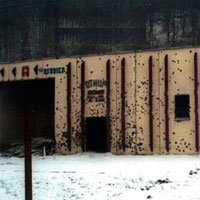

The Court of Appeals in Belgrade has dismissed (available in Serbian) the indictment filed against eight members of a Special Brigade of the Republic of Srpska Ministry of the Interior, accused of killing 1,313 civilians from Srebrenica in the Kravice hangar on July 14th, 1995 (Srebrenica – Kravica Case), with the explanation that the indictment was not filed by an authorized prosecutor. The Humanitarian Law Center thinks such a decision represents an inadmissible failure of the local judiciary, which will further jeopardize the process of war crimes trials, already deemed to be too slow.
The indictment was dismissed because the Office of the War Crimes Prosecutor (OWCP) did not have a prosecutor or an acting prosecutor appointed to either of these positions in the period between January 1st, 2016 and late May 2017, which included the time when the indictment for the crimes committed in Kravica was filed. Such a vacuum inside the Office of the War Crimes was caused by omissions for which the legislative, executive and judicial powers should jointly be held responsible. Namely, the Parliament and the Government of Serbia failed to take steps to appoint a new War Crimes Prosecutor for almost a year and a half from December 31st, 2015, when the mandate of the former War Crimes Prosecutor, Vladimir Vukčević, terminated. At the same time, the Republic State Prosecutor Zagorka Dolovac also failed to appoint an acting war crimes prosecutor.
The Humanitarian Law Center has been pointing to the problems faced in the process of war crimes prosecution which have occurred owing to this failure to appoint a war crimes prosecutor for almost a year and a half; it was one of several concerns expressed by the HLC in its 2016 Report on War Crimes Trials. However, we are now also pointing to the unbelievable decision made by the Republic’s Public Prosecutor, Zagorka Dolovac, not to appoint an acting war crimes prosecutor either, even though this obligation is prescribed by the Law on Public Prosecution (available in Serbian). It is clearly stated in this Law that, If the term of office of a public prosecutor is terminated, the Republic’s Public Prosecutor shall appoint an acting public prosecutor until a new public prosecutor takes office, for a period not exceeding one year. By failing to do this, the Republic’s Public Prosecutor has obstructed the lawful work of the OWCP in the period when it did not have an appointed prosecutor.
The Republic’s Public Prosecutor Zagorka Dolovac is well aware of this legal obligation, as is confirmed by the fact that in late 2015, she handed down Decisions towards Appointing Acting Prosecutors (available in Serbian) in more than 30 prosecution offices in the state, which were in the same position as the OWCP. Only one position was missing, and that was the position of Acting War Crimes Prosecutor. Because of this fact, there was no authorized prosecutor in war crimes trials in the period January 1st, 2016 until May 31st, 2017. All of this suggests that the omission by Zagorka Dolovac was not accidental.
By her unlawful actions as regards her failure to appoint an acting prosecutor in OWCP, the Republic’s Public Prosecutor has directly obstructed the process of war crimes prosecution in Serbia. The legitimacy of such decisions and actions, not only in the Srebrenica-Kravica Case, as were made and undertaken by deputy OWCP prosecutors as of January 1st, 2016 until the newly appointed war crimes prosecutor took office on May 31st, 2017, are now to be questioned, and it is possible that this could represent a basis for challenging decisions rendered in other cases as well. All of this could lead to the further challenging of the process of war crimes trials before the domestic judiciary (some of the cases include Lovas, Ovčara and Ćuške, which have been pending for seven to 13 years). The Republic’s Public Prosecutor has caused immense damage to victims and their families by this decision, and, at the same time, she has publicly obstructed the fulfillment of obligations undertaken by the Chapter 23 Action Plan and the National Strategy for the Prosecution of War Crimes.
The HLC hereby wishes to warn everyone concerned that the latest stalling and obstruction, if observed in the context of a situation in which persons accused die (available in Serbian) and witnesses lose trust in the Serbian judiciary and refuse to testify in trials which have a tendency to start over and over again, can only lead to judgments failing to be delivered at all, and even to the breakdown of the process of war crimes prosecution in Serbia.
This is not the first case in which procedural omissions have led to the stalling of war crimes trials (for instance, the judgment in the Ovčara Case was annulled because of such omissions four years after it became final, and the process has still not been completed 13 years after the indictment was filed); and it would not be the first time that no one is held responsible for such omissions. One might therefore refer to this as a system of obstruction of war crimes trials by state authorities, rather than a matter of accidental omissions. The Humanitarian Law Center believes that the omission for which the Republic’s Public Prosecutor was responsible and the consequent dismissal of the indictment filed in the Srebrenica – Kravica Case, could only be possible with a judiciary and a state which are only seeking for ways in which to take the issue of war crimes trials off their agenda.