
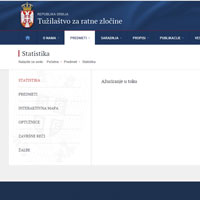
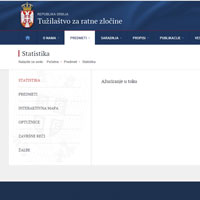
 Due to the frequent removal of the content from the official website of the Office of the War Crimes Prosecutor (OWCP), the Humanitarian Law Center (HLC) wishes to point out a tendency to put at risk the public’s right to know about the war crimes trials taking place in Serbia. Namely, over the past few weeks, the contents of the war crimes cases that have been processed or are still being prosecuted before the War Crimes Chamber of the Belgrade High Court have been removed from the official website of the OWCP.
During previous years, the website of the OWCP was a rare example of the well-designed and satisfactory page of a state body full of content, where the public was able to become acquainted with documentation of cases that had been prosecuted or whose prosecution was ongoing. However, instead of the different sections of this webpage being updated with new content in a timely manner, it is now no longer possible to find submissions of even elementary information regarding previous statistics, cases, indictments, closing arguments or complaints. By removing the stated content, the public’s right to be informed in a continuous and timely manner about the indictments, as well as about the phases of individual war crimes proceedings, has been endangered.
The HLC emphasises that, in the context of dealing with the past, it is necessary to provide for mechanisms that enable the communication of objective and timely information to the public. Thus it is that the UN Principles to Combat Impunity say that “… all people have an inalienable right to know the truth about the crimes committed in the past and the circumstances that led to them…” However, informing citizens of war crimes trials in Serbia remains a serious challenge for the judicial authorities responsible for the prosecution of war crimes. Some of the key problems in the domain of public information include the absence of special information programmes (so-called ‘outreach’), excessive anonymisation of judgments, as well as the inability to videotape a trial (available in Serbian only) for the purpose of public display.
The stated problems have significantly affected the poor visibility of war crimes trials in Serbia. The HLC points out that the latest public opinion survey shows that an alarming 85% of respondents
cannot state any war crime that has been or is being prosecuted in Serbia, that as many as 79% are not able to indicate the name of any judicial authority responsible for prosecuting war crimes in Serbia, and that 59% of respondents think they are poorly informed about war crimes trials.
The HLC also recalls that one of the reasons for the adoption of the National War Crimes Prosecution Strategy was the need to raise the level of general social awareness about the importance of punishing war crimes perpetrators. Bearing in mind the above, the HLC calls on the OWCP to continue with the timely updating of content data on its website, in order to respond to the need to inform the public about its work, which would certainly contribute significantly to the improvement of the overall attitude of society towards the importance of war crimes prosecution.