
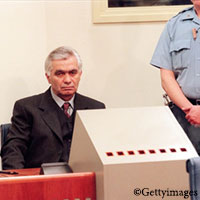
 The Office of Tomislav Nikolić confirmed on January 11th, 2017, that he is going to meet the wartime Speaker of the Republic of Srpska Parliament, the convicted war criminal Momčilo Krajišnik, in the building of the General Secretariat of the President of the Republic of Serbia, Belgrade. The Humanitarian Law Center (HLC) maintains that this move made by the President represents an unacceptable mockery of the victims, and is in direct contradiction with the proclaimed intention of Serbia to work on reconciliation in the region.
Momčilo Krajišnik was finally convicted before the International Criminal Tribunal for the Former Yugoslavia (ICTY) in March 2009, to 20 years of imprisonment for the deportation, forcible removal and expulsion of a non-Serb civilian population as a crime against humanity. Krajišnik was a member of the joint criminal enterprise aimed at altering the ethnic composition of the part of Bosnia and Herzegovina under the control of the Serbs by expelling the non-Serb population. Upon delivery of the final judgment, he was transferred to a prison in Great Britain, from which he was released in 2013 after serving two thirds of his sentence. On this occasion, the municipal authorities in Pale, Bosnia and Herzegovina (BiH), organized an official welcoming party for him.
Throughout the entire war in BiH, Momčilo Krajišnik was the Speaker in the Republic of Srpska Parliament, a prominent member of the Serbian Democratic Party, and an unofficial member of the Republic of Srpska Presidency, and as such he represented one of the key figures of the wartime government structures of Bosnian Serbs. His contribution to the joint criminal enterprise, according to the allegations in the ICTY trial judgment, was to “help establish and perpetuate the SDS party and state structures that were instrumental to the commission of the crimes”. On the basis of the evidence presented during the trial, which lasted for two and a half years, the judges came to the conclusion that he intended to execute “a mass expulsion of a civilian population”, and that he “accepted that many Muslims and Croats of all ages would pay a heavy price” for “the achievement of Serb domination and sustainable statehood” [par. 1119].
Today, Momčilo Krajišnik, as the President of an association bearing the symbolic name “Creators of the Republic of Srpska”, arrives in Belgrade and meets the President of Serbia.
The HLC holds that the decision of the President of Serbia to meet with Krajišnik is not only a sign of support to the Republic of Srpska, like the support that he has recently given in Banja Luka, but also represents a statement that the government which he leads supports the manner in which the Republic of Srpska was created during the war with the help of Krajišnik’s great contribution, and the use of the army and ethnic cleansing on the occupied territories.
The HLC would also like to remind the public that this is not the first visit by Krajišnik to public instititutions in Belgrade, nor is this the first time that the authorities in Serbia have publicly accorded honour to convicted war criminals. Namely, in April last year, Momčilo Krajišnik held a promotion of his book “How the Republic of Srpska was born” at Dom Omladine, a cultural institution run by the City of Belgrade. The book promotion was briefly interrupted by activists of the Youth Initiative for Human Rights, who were afterwards physically assaulted and taken out of the hall, whilst the promotion was completed without any further problems.
At the same time, the highest-ranking representatives of the current government in Serbia have shown respect to this convicted war criminal during previous years as well. For instance, after serving two thirds of his 14-year prison sentence for crimes against Albanian civilians in Kosovo in 1999, General Vladimir Lazarević was transported to Serbia by a plane owned by the Government of the Republic of Serbia and then attended an official welcome ceremony in the presence of three ministers and other high-ranking government officials, including the Chief of the General Staff of the Serbian Army.
The HLC would like to remind the public that international institutions have harshly criticized Serbia because of such actions. The European Parliament called on Serbia to “refrain from gestures such as publicly welcoming the return of individuals convicted of war crimes” in its Resolution on 2015 Progress Report on Serbia. The Chief Prosecutor of the International Criminal Tribunal for the Former Yugoslavia mentioned that “the fact that senior government ministers escorted and welcomed a convicted war criminal, General Vladimir Lazarević, back to Serbia upon his release, sends absolutely the wrong signal” [in the context of the obligation of national judiciaries to prosecute war criminals] in his Report to the Security Council for 2015.
The HLC emphasizes that the government, by honouring convicted war criminals and organizing meetings between them and the highest government officials, obstructs the process of dealing with the causes and consequences of the wars of the 1990s, and that what is particularly worrisome is the fact that such actions are damaging to the dignity of the victims.