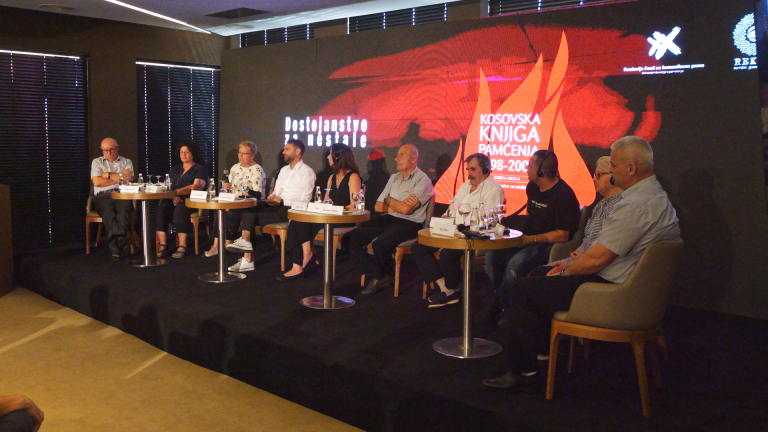

 BELGRADE, September 28th, 2011 – A few days ago, the Humanitarian Law Center published a remarkable book. It can be said to represent a milestone in relations between the peoples of former Yugoslavia, in the past 20 years of the postwar period.
The book in question is The Kosovo Memory Book: 1998-2000, the first volume. The book lists chronologically, by municipalities, all the Serbs and Albanians killed in the clashes in Kosovo in 1998. In the remaining volumes which are planned to come out soon, victims of 1999 and 2000 will be presented in the same way. The book was published in Serbian, Albanian and English. With every tragic event, in addition to the name, father’s name and last names of those killed, the list provides a date, place and brief description of the event. The methodology, consistently and professionally carried out throughout the book, places this publication it in a lexicographical work par excellence.
The book is a Kosovo necrologue of sorts, whose numerous features and unique characteristics make it quite extraordinary. Nothing like this has been attempted in Serbian science, literature, or journalism in the past 20 years, since the beginning of the wars in this region and since the breakup of Yugoslavia.
- First of all, the victims were given back their names, the date, place and circumstances of the killing. They are no longer anonymous or reduced to a number. This is very rarely done anywhere in the world, even in much wider and more serious armed conflicts and sufferings.
- For the first time in Serbia’s oral and written discourse after 1990, Albanians, without exception, are treated as equal to Serbs. There is not a single negative, degrading or discriminatory attitude towards any Albanian in the book.
- The content and approach to the subject of this book is the first step in dealing with the past and toward reconciliation of Serbs and Albanians.
- The book’s great value and quality are the short records that accompany every case of murder, describing the circumstances under which the killing occurred. These are concise, objective and above all absolutely impartial texts that give account of the event with no adjectives, positive or negative connotation, without any pathos, emotion or any sort of mystification. This kind of approach evokes the pure truth of every event in which Albanian and Serb men, women and children were killed, thus contributing to comprehensive understanding of these tragic, terrible and horrible killings. To show how great, important and excellent these short essays are, we will make a comparison. The most important lexicographical work in the former Yugoslavia was The Encyclopedia of Yugoslavia, popularly known as the Yugoslavica, in eight volumes, published by the Lexicographic Bureau from Zagreb, led at the time by Miroslav Krleza. In 2007, the Zagreb journal “Kolo” (1:2007) published the entries from an article “The Marginalia of the Encyclopedia of Yugoslavia” from the Krleza legacy; the entries were arranged in alphabetical order. Significant differences and even diametrically opposed views arise from hitherto unpublished entries in Krleza’s text and those finally published in the Yugoslavica. Hence, even the influential and powerful Krleza had to make compromises, had to apply self-censorship and publish what he disagreed with. But that’s certainly not the case with The Kosovo Memory Book. It publishes only facts and nothing but the truth as the highest criterion of the mind and spirit.
- The book is complied very professionally, accompanied with a number of appendixes: an index of persons who were killed or forcibly disappeared; an index of sites where the killings took place or where a person was last seen; an index of places of residence of killed or forcibly disappeared persons; and finally a registry of sources, with shortened and full titles. The book contains 10 tables with statistical data.
Finally, I wish to express how glad I am that two of my young colleagues, Sandra Orlovic and Mira Lazic, played such a significant part and gave such great contribution to this crucially important work. I have had the pleasure to recognize their human, intellectual and professional qualities at the beginning of their careers, and I have been promoting them in my own way.
The author is a legal advisor to the Center for Euro-Atlantic Studies.