

 When activists protested against an event organised by the ruling party promoting a convicted war criminal, we were fined – showing again how Serbian officials still reject the truth about the 1990s conflicts.
In November 1991 in Vukovar in Croatia, around 260 people were killed in what is known as the Ovcara massacre. On Tuesday, we who raised our voices against the perpetrators of this crime were fined by a Serbian court.
I was one of eight activists from the Youth Initiative for Human Rights in Serbia who were each fined 50,000 dinars (about 420 euros), for protesting against the promotion of a book by convicted war criminal Veselin Sljivancanin in January last year.
The eight of us who were fined were born in the 1990s, and our entire lives were negatively affected by the war, while those who committed horrible crimes and mass atrocities back then are now welcomed and praised by Serbian institutions and the wider public.
Sljivancanin, a former officer in Yugoslav People’s Army, was one of four officers indicted by the International Criminal Tribunal for the Former Yugoslavia for crimes committed at Ovcara. His indictment was based on the fact that he was in direct command of Yugoslav People’s Army forces that took control over Vukovar hospital, from which non-Serbs were taken to Ovcara and later executed.
In the end, he was sentenced to 10 years in prison by the ICTY for aiding and abetting the torture of prisoners.
But after Sljivancanin served his sentence, he returned to Serbia, where he was (and still is) perceived as a national hero.
Very soon, he started to become engaged in politics by supporting the ruling Serbian Progressive Party. In January 2017, during the presidential election campaign, the Progressive Party organised a public promotion of Sljivancanin’s book in Beska, a village near Indjija in northern Serbia.
The event was organised at a municipal cultural centre, a public space financed by all citizens of Serbia. Even before this though, representatives of Serbian institutions already had a rich history of embracing convicted war criminals and organising official welcomes after their returns from prison, as in the cases of Vladimir Lazarevic and Nikola Sainovic.
During the public event in Beska, activists from the Youth Initiative for Human Rights, a Belgrade-based NGO, came to protest against the promotion of a convicted war criminal by the ruling party.
We blew whistles and unfurled a banner which said “War criminals should be silent so that the victims can be spoken about!”, after which a group of Progressive Party supporters and representatives of the local municipal government tore down the banner and physically attacked us. Two of us ended up in hospital and our car was damaged.
After the event, a state-organised campaign against us began. Pro-regime tabloids called us “fascists” and “hooligans”, and right-wing extremist groups came to the Youth Initiative for Human Rights’s office.
Finally, we were convicted by the misdemeanour court in the town of Ruma of violating the law by disrupting Sljivancanin’s book event.
Let’s remember that Serbia adopted its Law on Cooperation with the Hague Tribunal in 2002, eight years before Sljivancanin was convicted, therefore his verdict is legally recognised by the Republic of Serbia. So the question is, why can’t a man convicted of war crimes be publicly called a war criminal?
Unfortunately, the example of Sljivancanin is only one of many similar cases that show the strong support of Serbian institutions for war crimes and their perpetrators.
At the moment, one of them is even sitting as an MP in the Serbian parliament (Vojislav Seselj), while the Ministry of Defence is publishing the war diaries of another (Nebojsa Pavkovic) and publicly promoting them at the Belgrade Book Fair.
Seselj was found guilty for crimes against humanity and sentenced to 10 years in prison, while Pavkovic was found guilty of the persecution, murder and deportation of Kosovo Albanians and sentenced to 22 years.
Also worth mentioning is the case of Vladimir Lazarevic, who was invited to be a guest lecturer at the Serbian Army’s Military Academy a few months ago. Lazarevic was sentenced to 14 years in prison for committing war crimes and crimes against humanity during the war in Kosovo.
So when exactly did the fact that a crime was committed during the war become a mitigating circumstance? There is public outrage over individual crimes, but no public empathy for war crime victims who were killed by people hiding behind the Serbian flag.
Somehow, along the way, it turned out that patriotism and loving your country means supporting war criminals and praising them as heroes – as long as they are ‘ours’, of course.
Meanwhile we who went to Beska to protest against the public promotion of war crimes perpetrators were sentenced within a year, but some of the war crime trials currently ongoing in Serbia have continued for over a decade, without any sign of ending. Evidence is getting lost and victims are getting tired and increasingly unwilling to participate in legal processes that clearly won’t bring them any satisfaction.
Our misdemeanour convictions sent a clear message that war criminals are not only tolerable, but desirable in public life. Those who have been legally found responsible for killings, deportations and other mass atrocities are supported by our officials and welcomed by our institutions – and everyone who doesn’t accept this is called a traitor or foreign agent.
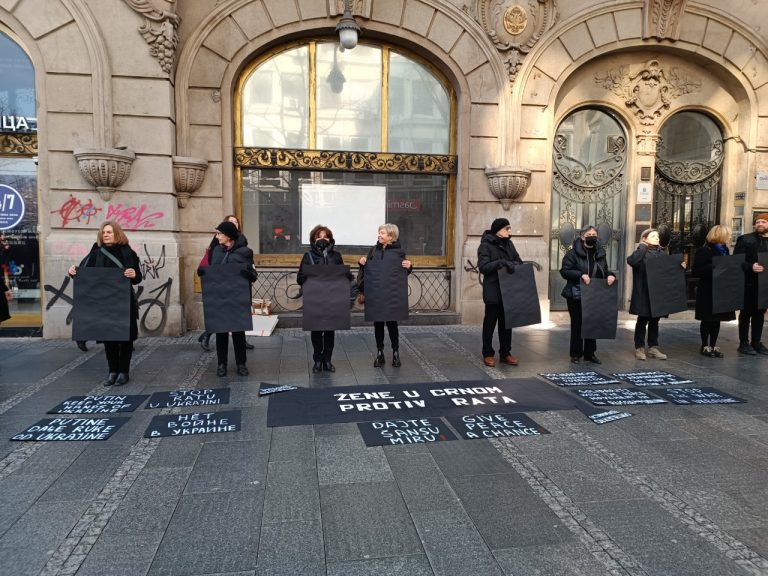
That’s why the Youth Initiative for Human Rights is calling on the Serbian public to attend a protest that will be held on Thursday in Belgrade – to show that there are still people who disagree.
Jovana Prusina is a former Youth Initiative for Human Rights activist in Serbia. She is now programme coordinator for BIRN’s Balkan Transitional Justice programme. This article was written in a personal capacity.
The opinions expressed in the Comment section are those of the authors only and do not necessarily reflect the views of BIRN.