
 OVER the weekend Kosovo Albanians have been celebrating the fifth anniversary of Kosovo’s declaration of independence. At the same time Hashim Thaci, Kosovo’s prime minister and Ivica Dacic, his Serbian counterpart, are preparing for another round of European Union (EU) sponsored talks in Brussels. According to Cathy Ashton, the EU’s foreign policy high representative, the two-day session that will begin on February 19th will be the “most important part” yet.
Both prime ministers have been accused in their respective countries of treachery. Even so, they have decided to try to strike a historic deal. If they can, it will boost the theory that only hardliners in such situations can do business together. Mr Dacic used to be the spokesman of Slobodan Milosevic, the Serbian leader who went to war with NATO over Kosovo in 1999. Mr Thaci was the political head of the Kosovo Liberation Army (KLA) guerrillas who took on the Serbs in the war that began in 1998.
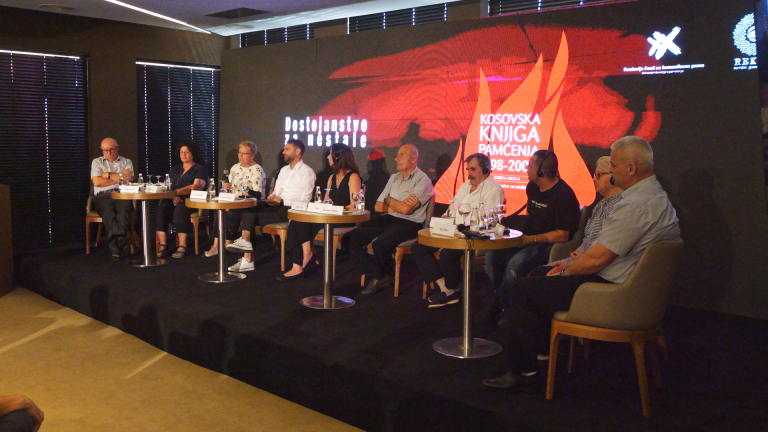
At this crucial juncture, it is worth recalling the human suffering that brought them to this point. The Humanitarian Law Center in Kosovo and Serbia has been working for years to compile an exact list of everyone who died as a result of the war within Kosovo’s borders and to give an account of how each person died.
One volume has been published and three more are being prepared. The stories, which come from multiple sources, including HLC interviews, are extraordinary and moving. It is also almost certainly a first for such a book to be produced.
According to Natasa Kandic (pictured above), founder of the HLC and director of the book project, just having a list of names is not enough. “For history and for future generations it is important to know what happened to people.” The Kosovo Memory Book is unique because Serbs and Albanians are in one book together, as are KLA fighters, Serbian police and soldiers.
What is shocking about so many of the stories is their sheer banality, which makes them all the more tragic. Here are a few examples. (In the book all the place names are in Serbian and Albanian. Here our correspondent gives just one.)
Tahir Krasniqi, born in 1967, was a farmer with two children:
“He disappeared on 2 June 1998. Since then all trace of him has been lost. To this day, the Krasniqi family knows nothing of what happened to him. His disappearance is entered on the ICRC list of missing persons under BLG-802615-01.”
Velika Petrovic, was born in 1943. She had six children. From the names and context we can understand that Mrs Petrovic was a Serb. On 17 July 1998 a friend and her husband Dusan were standing guard overnight. At 4.00am Mrs Petrovic went to her home’s outside lavatory. Dusan “heard the sound of footsteps…and thought someone was prowling about. In fear he fired a bullet from a hunting rifle in the direction of the sounds and accidentally killed Velika.”
Ylfete and Mejreme Mullaabazi were born in 1933 and 1944 respectively. They lived in Orahovac. On 20 July 1998 Serbian police entered the part of town where they lived, ordered everyone out and set their houses on fire. The people left to flee over the hills.
“Ylfete and Mejreme and others among the elderly could not walk fast, and consequently lagged behind their relatives. The Serb police fired at this group of elderly people, hitting Ylfete and Mejreme in the back and killing them instantly.”
Trajko Stankovic was born 1944. He was a farmer with six children:
On 11 August 1998 Trajko went to Pristina to collect his pension cheque, but never returned home. Two days later, Trajko’s sister Stana learnt from some Albanian children from the village that Trajko had been stopped on 11 August 1998 by some KLA members, including the KLA commander for Kolovice, and taken away in a yellow van towards the village of LLukar. His subsequent fate has remained unknown. Trajko is registered on the ICRC list of missing persons under BLG-803928-01
Xhevat Shala was born 1972. He had three children and was a member of the KLA.
“Xhevat was with his unit holding his position in the village. On 25 September 1998, at about 15:00h, Xhevat was holding the position near the place called Pig’s Head and was shot just as he came out of a trench to check the terrain.”
Zvonimir Bojanic was born in 1945. He was the vice president of the municipality of Kosovo Polje just outside Pristina.
“On 17 December 1998 at 21:40h, five plain clothed men identifying themselves as members of the KLA came to Zvonimir’s house in Velika Slatina. One of the men was masked. Zvonimir was in the company of his brother Zivojin and godmother Svetlana at the time. When Zvonimir refused to come with them to Lausa where the KLA had its headquarters, they handcuffed him, tied up his brother Zivojin with chains and locked Svetlana up in the room. After looting money and valuables from the house they took Zvonimir outside. His body was found the next morning at around 06:00h on the main road connecting Pristina and Pec near the place called Careva Cesma. The body was left behind in the middle of the road and run over by an unidentified vehicle. Signs of torture were visible on the body, as well as gunshot wounds in the forearm and chest.”
Hasime Shabani was born in 1950. In 21 September 1998, when Serb forces drew near their village of Galice, the villagers set out in a convoy of tractors. Then the Serbs ordered them to go back. There was more shelling so they moved again.
“One shell went off near the tractor carrying Hasime and her children, wounding Hasime in the chest. She succumbed to her wounds the next morning. Her family buried later that day in the cemetery in the village of Baks.”
Sejdi Muja was born in 1946. He had 11 children. He was a forester. From the context it is clear that this is an example of one of the most sensitive and taboo issues in Kosovo, that is of Albanians killing other Albanians. Presumably Mr Muja was suspected of collaborating with the Serbs.
“On 12 January 1998 Muja went to work at 08:45 with his neighbor Selim Dibrani. As they were passing by the house of Lutvija Dibrani in the Dibrani neighborhood, three men in plain clothes, with masks on their faces emerged from a bush right in front of them. In Albanian, they ordered Selim to move on without turning around, and then shot at Muja, killing him on the spot.”
The total number who died or went missing in the war, and in the months that followed is 13,527. About 1,200 Albanians remain unaccounted for and 500 Serbs are still missing.